Troop + JTAC lifecycle
Source: src/CTLD_troop.lua, src/CTLD_jtac.lua
Entities: CTLDTroopGroup, CTLDJTAC, CTLDJTACDetector (static helpers), CTLDJTACMessage (static)
Singletons: CTLDTroopManager, CTLDJTACManager
Troops and JTAC are documented together because a JTAC is not a unit type — it is a capability that can ride on three different carriers, one of which is an infantry soldier inside a composite troop group. The troop state machine and the JTAC registry are therefore tightly coupled: deploying, extracting or losing a troop group has to start, freeze or tear down the JTAC instances that live inside it.
Both managers follow the singleton idiom described in Architecture: one
instance per domain, obtained via CTLDTroopManager.getInstance() / CTLDJTACManager.getInstance(),
each built on class() from src/core/class.lua. Cross-cutting notifications are published on the
event bus (EventDispatcher) — see Events for the full OnJTAC* /
OnTroops* catalogue.
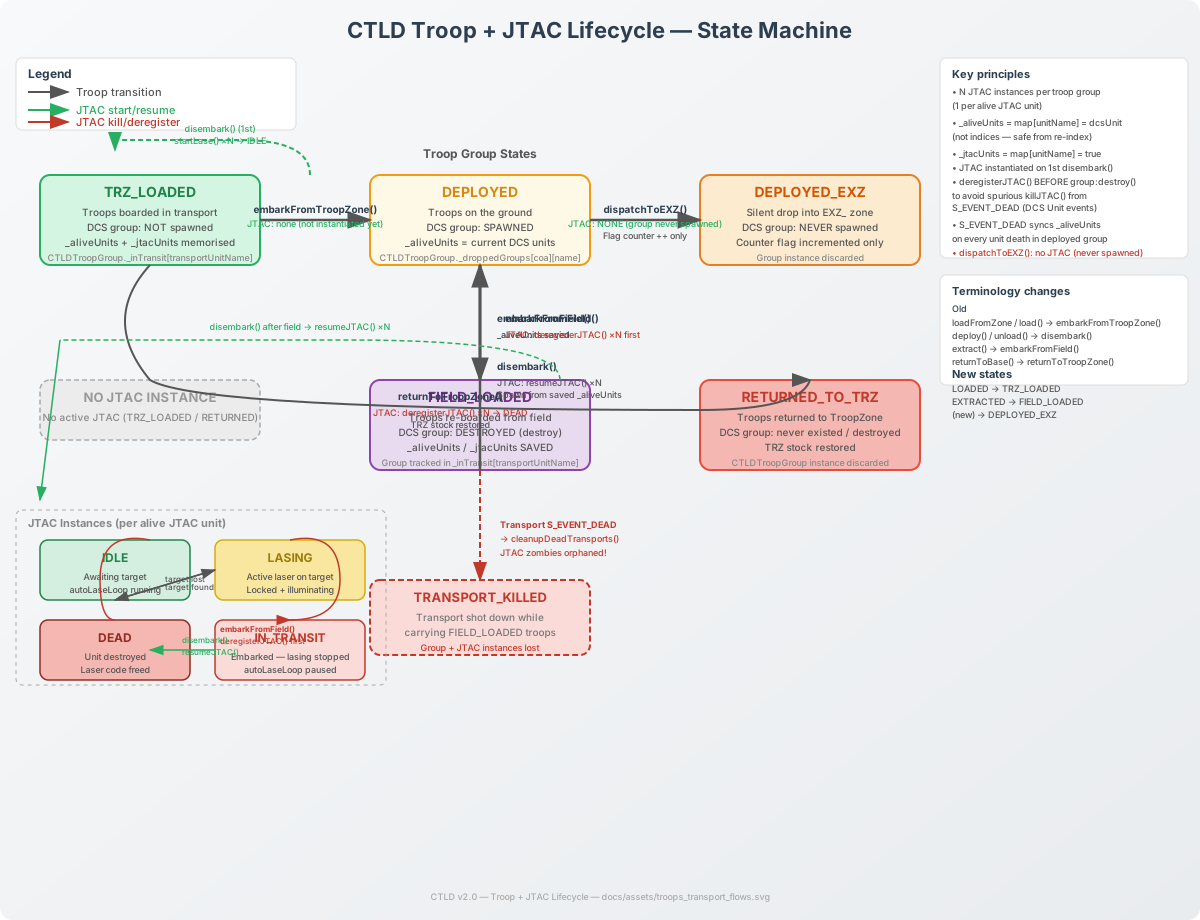
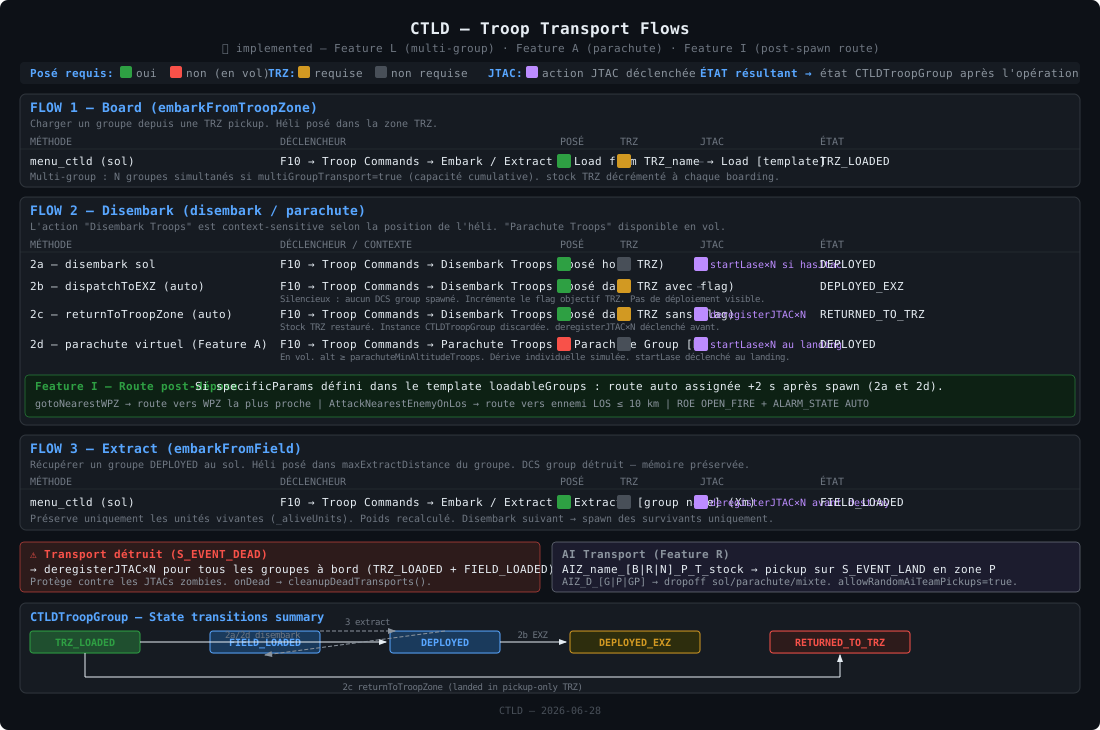
Two diagrams accompany this page:
- Troop + JTAC lifecycle state machine — every state and transition.
- Troop transport flows — load / deploy / parachute paths.
The three JTAC flavours
A JTAC descriptor drives lasing regardless of its DCS category. What differs between flavours is whether the carrier can be packed (destroyed back into crates) and whether it can be loaded (embarked onto a transport).
| Flavour | DCS category | Spawned by | Packable | Loadable | Registry key |
|---|---|---|---|---|---|
Troop (infantry with jtac=N) |
GROUND group | embarkFromTroopZone() → disembark() |
No | Yes — held virtually in _inTransit |
unitName (unit-keyed) |
| Vehicle (Hummer / SKP-11) | GROUND group | spawnJTACVehicleForTransport() or crate unpack |
Yes — packVehicle() → deregisterJTAC() |
Yes — loadVehicle() (virtual or DCS-native) |
groupName (group-keyed) |
| Drone (MQ-9 / RQ-1A) | AIRPLANE | deployAirJTAC() or drone crate (spawnAs = "AIRPLANE") |
No (aircraft) | No — aircraft are not cargo in CTLD | groupName (group-keyed) |
Detection is by descriptor flag only: a crate descriptor with isJTAC == true becomes a JTAC on
unpack. There is no separate JTAC_unitTypeNames table — that legacy setting was removed, and
drones now reach the map through the standard Request Equipment crate menu
(spawnAs = "AIRPLANE"), not a dedicated vehicle-spawn menu.
The vehicle- and drone-side spawn/pack/load methods live in the crate and vehicle managers
(CTLDVehicleSpawner:registerJTACVehicle(), CTLDVehicleSpawner:packVehicle(),
CTLDJTACManager:deployAirJTAC()); this page describes how they call into CTLDJTACManager, not
their internals.
Troop group state machine
A CTLDTroopGroup tracks troops from load to final disposal. It is not a DCS object — it lives
entirely in Lua memory, inside CTLDTroopManager._inTransit[unitName] (a list, so a transport can
carry several groups) or, once on the ground, as a name in CTLDTroopManager._droppedGroups[coalition].
CTLDTroopGroup.STATE declares five constants:
CTLDTroopGroup.STATE = {
    TRZ_LOADED      = "TRZ_LOADED",    -- onboard, loaded from a TroopZone
    DEPLOYED        = "deployed",      -- on the ground as a live DCS group
    FIELD_LOADED    = "FIELD_LOADED",  -- onboard, recovered from the field
    DEPLOYED_EXZ    = "DEPLOYED_EXZ",  -- (declared; see note below)
    RETURNED_TO_TRZ = "RETURNED_TO_TRZ",
}
The transitions actually driven by the current code:
                 embarkFromTroopZone()                    disembark()
   (pickup TRZ) ─────────────────────► TRZ_LOADED ───────────────────────► DEPLOYED
                                            │                              (DCS group spawned)
                                            │                                   │
                     returnToTroopZone()    │                                   │ embarkFromField()
              (instance discarded, stock    │                                   ▼
               restored, JTACs freed)  ◄─────┘                              FIELD_LOADED
                                                                                │
                                                     disembark() (re-deploy)    │
                                            DEPLOYED ◄──────────────────────────┘

   disembark() while inside an extract zone with objectiveFlag:
              troops counted into the flag, group:deploy(nil), no DCS group, no JTAC
- On a new load (
embarkFromTroopZone()) the group is stored in_inTransitwith_aliveUnits/_jtacUnitspre-built from the template role composition. No DCS group and no JTAC exist yet. - On deploy (
disembark()) the DCS group is spawned byCTLDObjectRegistry.spawnObject(),group:disembark(dcsGroup)runs_syncFromDCSGroup()to rebuild_aliveUnits/_jtacUnitsfrom the real DCS unit names, the group name is pushed into_droppedGroups, and its template/weight/total are cached in_droppedTemplatesfor accurate re-deploy after a field pickup. - On field pickup (
embarkFromField()) the nearest friendly dropped group is turned back into aFIELD_LOADEDCTLDTroopGroupand its DCS group is destroyed.
Note — declared-but-unassigned states. DEPLOYED_EXZ and RETURNED_TO_TRZ are declared in the
STATE table but the current paths do not assign them. An objective-zone drop reuses DEPLOYED
(via group:deploy(nil) — no DCS group, the extract zone's objectiveFlag is simply incremented by
group.unitTotal), and returnToTroopZone() discards the instance outright
(_inTransit[unitName] = nil) rather than parking it in a terminal state.
CTLDTroopGroup unit tracking
self._aliveUnits = {}  -- [unitName] = dcsUnit (DCS Unit reference, not an index)
self._jtacUnits  = {}  -- [unitName] = true (subset of _aliveUnits flagged as JTAC)
_syncFromDCSGroup() fully rebuilds both maps from the live DCS group. JTAC soldiers are
identified by the JTAC name prefix (name:match("^JTAC")), set by _registerOneTemplate()
for every jtac-role unit; the prefix is exclusive to that role — all other roles use
INF / MG / AT / AA / MORTAR / custom prefixes. Mortar servant crew (SVNT prefix) are
excluded from both maps and from unitTotal. Keying by unitName (never by group index) means DCS
re-indexing surviving units after a death cannot corrupt the tracking.
JTAC instance model
CTLDJTAC.STATE has five values: IDLE, LASING, ORBITING (flying, implies lasing),
IN_TRANSIT (ground JTAC embarked), and DEAD. The manager keeps one CTLDJTAC per alive JTAC
unit, not one per group — a composite troop group with two JTAC soldiers holds two entries.
Two registry conventions coexist in CTLDJTACManager.jtacs, distinguished by the entity's
unitName field:
| JTAC type | Entry point | Key in jtacs |
unitName field |
Loop resolves unit via |
|---|---|---|---|---|
| Drone / vehicle JTAC | startLase(groupName) → autoLase() → spawnJTAC() |
groupName |
nil |
Group.getByName(groupName):getUnits()[1] |
| Infantry JTAC in a troop group | startLaseTroopUnit(unitName) |
unitName |
set | Unit.getByName(unitName) |
The distinction is critical on death. A group-keyed JTAC whose DCS group has vanished is cleaned
up by killJTAC(groupName), which destroys the group and publishes OnJTACDead. A unit-keyed
infantry JTAC must never call killJTAC — doing so would destroy the whole composite group and
kill its surviving infantry. Instead its _autoLaseLoop simply returns nil (stops) when
Unit.getByName() fails, and cleanup is done by S_EVENT_DEAD → onUnitDead → deregisterJTAC(unitName).
Each JTAC is assigned a laser code from a pool (jtacLaserCodeMin = 1111 …
jtacLaserCodeMax = 1688, codes with a 0 or a 9 left out), drawn from the top and freed on death/deregister.
A code imposed by the caller (cfg.laserCode, autoLase(group, code)) goes through _resolveLaserCode(): it leaves the pool for good (jtac.codeImposed, never freed), a JTAC holding it automatically is re-coded by _recodeJTAC() (lasing stopped with STOP_REASON.CODE_CHANGED, code_changed message on its previous radio), and another imposed holder keeps it with a WARN.
A radio passed in cfg.radio is kept as given (jtac.radioSupplied, name defaulted, freq stringified); otherwise CTLDJTACDetector.calculateFMRadio() derives
an FM guidance frequency from the code (30 + floor((code-1000)/100) + ((code-1000) mod 100) * 0.05),
giving roughly 31.5–40.4 MHz across the pool.
JTAC spawn entry points per flavour
| Flavour | Path | JTAC registered by | Resulting state |
|---|---|---|---|
| Troop — load via TRZ then deploy | embarkFromTroopZone() → disembark() |
disembark() loops _jtacUnits, calls startLaseTroopUnit(unitName) for each |
IDLE → LASING |
| Troop — parachute drop | parachuteTroops() |
landing callback maps _jtacUnits slot names (_u<idx>) to spawned units by position, calls startLaseTroopUnit() |
IDLE → LASING |
| Vehicle — Request JTAC Equipment | spawnJTACVehicleForTransport() |
registerJTACVehicle() + startLase() |
IDLE → LASING |
Vehicle — unpack isJTAC crate (GROUND) |
_spawnUnpacked() → _dispatchPostSpawn() |
_dispatchPostSpawn() sees desc.isJTAC, calls startLase() + registerJTACVehicle() |
IDLE → LASING |
Drone — unpack crate (spawnAs = "AIRPLANE") |
_spawnUnpacked() → _dispatchPostSpawn() |
_dispatchPostSpawn() checks desc.isJTAC with no air/ground distinction, calls startLase() |
ORBITING |
Drone — deployAirJTAC() |
direct menu path → spawnFromDescriptor("AIRPLANE") |
deployAirJTAC() calls startLase() directly |
ORBITING |
embarkFromTroopZone() deliberately does not spawn anything — it stores a virtual CTLDTroopGroup
in _inTransit. This is why a JTAC soldier lases nothing while riding a transport (its DCS unit
does not exist yet). startLaseTroopUnit() tolerates a not-yet-alive unit: the first _autoLaseLoop
is delayed +1 s and simply re-polls.
Troop-JTAC transition rules per exit path
| Exit path | State | JTAC action required |
|---|---|---|
embarkFromTroopZone() |
→ TRZ_LOADED |
None — no JTAC instances exist yet |
disembark() (first deploy) |
→ DEPLOYED |
startLaseTroopUnit(unitName) for every key in _jtacUnits |
parachuteTroops() |
→ dropped group | On landing, startLaseTroopUnit() per JTAC slot mapped to a spawned unit |
embarkFromField() |
→ FIELD_LOADED |
deregisterJTAC(unitName) for every key in _jtacUnits BEFORE group:destroy() |
disembark() (re-deploy after field) |
→ DEPLOYED |
startLaseTroopUnit(unitName) for every key in _jtacUnits |
returnToTroopZone() |
instance discarded | deregisterJTAC(unitName) for every key in _jtacUnits |
disembark into extract zone with objectiveFlag |
→ DEPLOYED (no DCS group) |
None — no group spawned, no JTAC ever instantiated |
Transport destroyed while FIELD_LOADED |
entry removed | All _jtacUnits orphans → deregisterJTAC() in cleanupDeadTransports() |
The deregister-before-destroy ordering in embarkFromField() is the key correctness invariant:
group:destroy() fires S_EVENT_DEAD for each JTAC unit, and without prior deregistration that
event would falsely trigger killJTAC() on a JTAC that is actually being recovered, not killed.
Vehicle & drone transitions
Ground-vehicle and drone JTACs are group-keyed, so their load/unload/pack transitions call the
group-keyed CTLDJTACManager methods directly. Summary of the states they drive:
| Transition | Trigger | State before → after | jtacs[] |
JTAC action |
|---|---|---|---|---|
| Load (menu) | loadVehicle(method = menu_ctld) |
LASING/IDLE → IN_TRANSIT |
freed to nil |
setJTACInTransit() → setInTransit() (stop lase, free code retained on entity) |
| Load (DCS native) | vehicle enters transport bbox | LASING/IDLE → IN_TRANSIT |
freed to nil |
setJTACInTransit(); DCS unit stays alive, linked inside the aircraft |
| Unload (menu) | unloadVehicle(method = menu_ctld) |
IN_TRANSIT → IDLE |
recreated | resumeJTAC() → startLase() |
| Unload (DCS native) | vehicle exits transport bbox | IN_TRANSIT → IDLE |
recreated | resumeJTAC() → startLase() |
| Parachute vehicle | parachuteVehicle() |
LOADED → WAITING |
recreated | resumeJTAC() in the landing callback |
| Pack | packVehicle() |
LASING/IDLE → removed |
freed to nil |
deregisterJTAC() — silent, no OnJTACDead |
| Destroyed (combat) | S_EVENT_DEAD |
any → DEAD |
freed to nil |
killJTAC() publishes OnJTACDead |
| Drone destroyed | S_EVENT_DEAD |
ORBITING/LASING → DEAD |
freed to nil |
killJTAC() |
setJTACInTransit() calls the entity's setInTransit(), which stops the laser and sets state
IN_TRANSIT; while in transit _autoLaseLoop returns the search interval without probing DCS unit
existence, because the unit is intentionally absent from the map (destroyed on virtual load, or
hidden inside the aircraft on DCS-native load). deregisterJTAC() is the silent path
(vehicle packed back into crates): it stops lasing, releases target claims, frees the laser code,
removes the registry entry, and does not publish OnJTACDead — packing is not a combat death.
Drones cannot be loaded, so IN_TRANSIT never applies to them.
S_EVENT_DEAD synchronisation
Every death of a unit in a deployed troop group is routed from CTLDDCSEventBridge to
CTLDTroopManager:onUnitDead(unitName):
_findGroupByAliveUnit(unitName)locates the owningCTLDTroopGroup(searching_inTransitfirst, then reconstructing from_droppedGroups).wasJtacis captured before mutation (grp._jtacUnits[unitName] ~= nil)._removeDeadUnit(unitName)drops the unit from_aliveUnitsand_jtacUnitsand recomputesunitTotal.- If
wasJtac,CTLDJTACManager:deregisterJTAC(unitName)is called — the unit-keyed cleanup that frees the laser without touching the surviving composite group.
Transport kill with FIELD_LOADED troops
When a transport carrying FIELD_LOADED troops is shot down, the _jtacUnits those troops held are
still referenced in CTLDJTACManager.jtacs and would become orphan zombies (the DCS units no longer
exist, but the JTAC entries and their laser codes are still allocated). cleanupDeadTransports()
handles this: for every stale _inTransit entry whose transport Unit.getByName() no longer
exists, it iterates each group's _jtacUnits and calls deregisterJTAC() before clearing the
_inTransit slot. onTransportDead() triggers this cleanup immediately on the transport's death
event rather than waiting for the next poll tick.
Legacy terminology (v1 → v2)
The v2 rewrite renamed the troop lifecycle vocabulary to make the load/deploy/recover semantics explicit. See Migration v1 → v2 for the wrapper layer.
| v1 name | v2 name |
|---|---|
loadFromZone() |
embarkFromTroopZone() |
deploy() / unload() |
disembark() |
extract() |
embarkFromField() |
returnToBase() |
returnToTroopZone() |
LOADED state |
TRZ_LOADED |
EXTRACTED state |
FIELD_LOADED |
hasJtac (boolean) |
_jtacUnits (map) |
| group index-based tracking | unitName-based map tracking |
CTLDTroopGroup.deploy is kept as an alias of disembark for backward compatibility during the
transition.
Multi-JTAC target deconfliction
When several JTACs are active at once — any mix of infantry, vehicle and drone — CTLDJTACManager
stops them from all lasing the same target through a shared claim table:
self._claimedTargets = {}  -- { [enemyUnitName] = jtacKey }
-- jtacKey = unitName (unit-keyed infantry) or groupName (group-keyed vehicle/drone)
Claim lifecycle:
| Event | Action |
|---|---|
| JTAC locks a new target | _claimTarget(jtacKey, enemyUnitName) |
| Lasing stops (any reason) | _releaseTarget(enemyUnitName) — from _stopLaseAndPublish() |
| JTAC deregistered / killed | _releaseTarget() + _releaseAllTargetsFor(jtacKey) (belt-and-suspenders) |
cleanup() |
_claimedTargets = {} |
Target selection (search phase of _autoLaseLoop), gated by ctld.gs("JTAC_targetDeconfliction")
(enabled unless explicitly false):
CTLDJTACDetector.findAllVisibleEnemies()returns every LOS-visible enemy withinJTAC_maxDistance, sorted by priority then distance. Priority tiers:hpriority(1) >priority(2) > Air Defence (3) > standard (4). LOS usesland.isVisiblewith a +2 m height offset on both endpoints.- Iterate the candidates, skipping any
candidate.unitNamealready in_claimedTargets. - The first unclaimed candidate is claimed before DCS spots are created — preventing a concurrent JTAC loop from grabbing the same target within the same scheduler tick — then lasing starts.
With deconfliction disabled, the loop simply takes candidates[1].
Target renewal (the critical case — target destroyed or LOS lost): _stopLaseAndPublish()
releases the claim on the lost target, and execution falls straight through to the search phase in
the same _autoLaseLoop tick, so the JTAC immediately picks the next unclaimed candidate from a
fresh findAllVisibleEnemies() call. Several JTACs losing their target simultaneously (e.g. one
explosion) therefore each acquire a different next target instead of converging on the same one.
CTLDJTACDetector.findNearestVisibleEnemy() is now a thin wrapper returning
findAllVisibleEnemies()[1], kept for callsites that only need the single best candidate and do not
require deconfliction.